
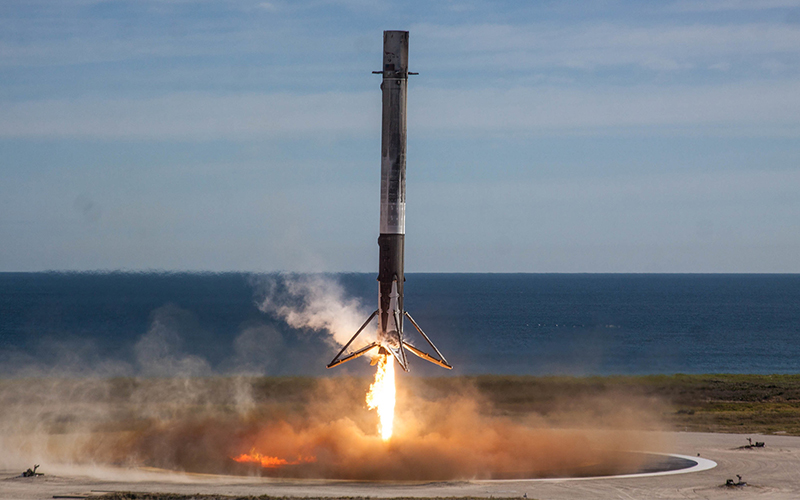
A rocket landing closes one flight and opens another engineering problem. The stage must return from the recovery area, be inspected, receive whatever maintenance its condition requires, and enter a new mission’s acceptance process. The dramatic descent is only the visible part of a transport system that now has to manage used hardware as a fleet.
That distinction helps explain both the appeal and the limits of reuse. Recovering an expensive assembly can reduce the number of new assemblies a launch provider must manufacture. It does not remove the need for an upper stage, propellant, people, launch infrastructure, or a customer-ready mission. Reuse changes how those resources are organized rather than making their costs disappear.
Start by asking what comes back
“Reusable rocket” is a description of an architecture, not a guarantee that every part of the vehicle returns. Falcon 9, for example, is a two-stage launcher whose recovery program includes first stages and payload fairings. Its payload user’s guide discusses the inspection and servicing of recovered hardware. The upper stage remains a separate element of the mission, so a booster reflight should not be mistaken for the reflight of the entire launch vehicle.
Spaceflight has used other approaches. The space shuttle combined a reusable orbiter and recoverable solid boosters with an expendable external tank. ESA’s shuttle technical overview illustrates why a single reusable label can conceal several different recovery and refurbishment systems. A winged vehicle landing on a runway creates different ground operations from a booster retrieved at sea, even when both save hardware for another flight.
The useful comparison is therefore specific: which structures, engines, electronics, and protective systems are recovered, and what must happen before each can be accepted again? Two vehicles can achieve a landing while imposing very different workloads on their operators. Counting recovered components is a starting point, not a complete measure of the operating model.
The return journey begins during ascent
A stage cannot spend the same propellant twice. If its recovery requires engine burns, the flight plan must accommodate those burns as well as the work of accelerating the payload. Depending on the design and mission, the vehicle may need to change its path, manage atmospheric entry, and reduce its speed before touchdown. Recovery hardware also has mass that the launcher must carry.
This is a system trade rather than an argument that recovery is inherently inefficient. The rocket equation explained by NASA Glenn connects changes in velocity to exhaust performance and the vehicle’s changing mass. A provider evaluates recovery within that mass budget. A mission that uses the vehicle’s performance differently can consequently demand a different recovery plan or an expendable configuration.
Landing location becomes part of mission design, too. A return close to the launch site and a landing farther along the flight path do not require the same trajectory. Neither is simply the premium version of the other. The choice has to fit payload needs, the vehicle’s capabilities, safety constraints, and available recovery infrastructure. Public payload figures should always be read with their configuration assumptions attached.
Recovery creates a second logistics network
A launch provider already needs a way to move stages and spacecraft into the launch campaign. Reuse adds a flow in the opposite direction. A recovered stage must be secured, transported, processed, and assigned somewhere in the fleet. The landing zone or recovery ship is thus connected to the same production-and-launch system as the factory and pad.
The shuttle’s solid boosters make that operational point tangible. NASA describes how the boosters separated, descended under parachutes, and entered the Atlantic for recovery. Its solid rocket booster recordation documents a recovery method very different from a powered landing on a platform. The shared requirement is that equipment returning from flight must reach an appropriate processing chain before another mission can use it.
Recovery assets can also become scheduling resources. A provider cannot treat a stage, a launch pad, an integration building, and a recovery platform as interchangeable stock. Each has a location and a readiness state. A fleet-management explanation of launch cadence should account for these connections rather than attributing every fast turnaround to the booster alone.
Inspection is part of the capability
Returning hardware brings information as well as material. Flight measurements and postflight observations can help engineers understand how components behaved under actual operating conditions. SpaceX’s user guide presents the servicing and inspection of reused hardware as a source of design and procedural learning. That is a manufacturer’s description of its program; it is not permission to assume every recovered component has an unlimited service life.
A customer’s acceptance decision remains mission-specific. NASA’s March 2025 Crew-10 readiness account describes the consideration of test data, inspections, and findings from another booster’s postlanding event. It offers a concrete example of a review process that reaches beyond whether the assigned stage has previously completed a successful flight.
The phrase “flight-proven” consequently needs context. It establishes that hardware has a flight history, not that inspection is optional or that all previous uses were identical. Relevant questions include what environments it experienced, what was replaced or repaired, and what evidence supports the next mission’s requirements. Detailed answers may not all be public, but their absence from a broadcast should not be confused with their absence from the engineering process.
Turnaround time is not the same as launch capacity
The interval between two flights of one booster is a useful observation. By itself, however, it does not describe the capacity of an entire launch service. A provider can distribute missions across several stages while processing others. Conversely, a ready booster cannot launch a payload whose own tests, permits, integration work, or orbital opportunity are incomplete.
The U.S. Space Force’s 2020 announcement on Falcon reuse for national security launches shows that introducing reuse also involved changes to the customer’s contracted service. It was not solely a hardware milestone. Qualification, oversight, mission assignment, and customer confidence all influence how a reusable fleet can be used.
Launch cadence should therefore be examined at several levels: the individual vehicle, the launch site, the manufacturing system, and the collection of customers ready to fly. An impressive figure at one level can coexist with a bottleneck at another. This approach makes a more informative comparison than treating the shortest published turnaround as a universal waiting time for every customer.
The economics depend on useful flights
Reuse can spread the manufacture of a recovered assembly across several missions, but the saving depends on how often that assembly actually flies and what each return costs to process. A design with little work between flights offers a different proposition from one that needs extensive intervention. Neither a landing video nor a single advertised launch price exposes the full accounting.
Public assessments should distinguish the price charged to a customer from a provider’s internal cost. They should also separate a routine mission from one that requires unusual integration, security arrangements, or trajectory work. Reuse is one influence on that commercial service. It does not make two otherwise different launch contracts directly comparable, and it does not justify inventing a precise saving when the necessary cost data are unavailable.
Demonstrators test operations as well as flight
New recovery programs have to establish the complete sequence, not merely copy the appearance of a successful landing. JAXA’s CALLISTO research description identifies guidance and control, propellant management, and engine maintenance as central areas of work. These are connected problems: the way a vehicle flies can affect its condition, and the maintenance burden can affect how often it is practical to fly it.
ESA’s Themis program similarly treats a reusable rocket prototype as a platform for demonstrating technologies involved in vertical takeoff and landing. A demonstration flight and a mature commercial service are different stages of development. Readers can track the transition by looking for evidence of repeated operation, well-understood maintenance, customer acceptance, and a launch-and-recovery system that works together.
The strongest evidence of practical reuse is therefore cumulative. Hardware returns, the team learns its condition, appropriate work is completed, and another mission accepts and flies it. That cycle shifts attention from a spectacular maneuver to the organization behind it—the people, facilities, procedures, and decisions that turn recovered machinery into a dependable transport resource.