
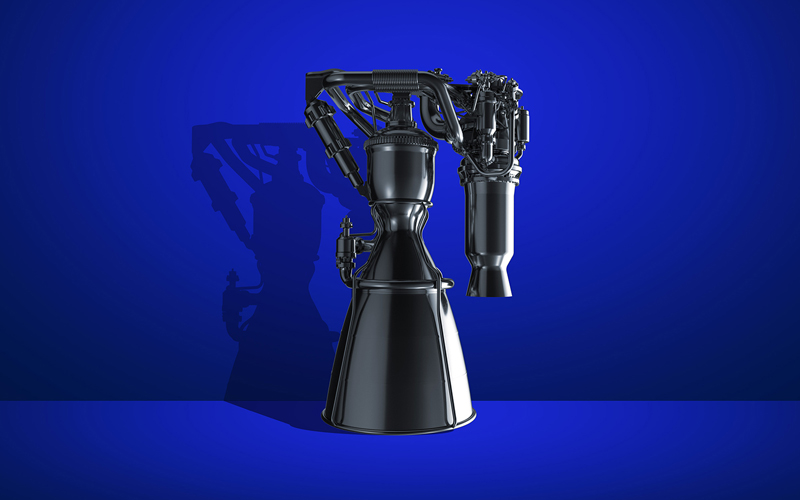
Choosing a rocket fuel also means choosing tanks, plumbing, cooling arrangements, loading procedures, and a demanding set of tests. The growing interest in liquid methane is best understood at that system level. An engine does not become a useful launch system because its fuel has an attractive label; the surrounding hardware must make that choice work reliably.
“Methalox” is shorthand for methane fuel paired with liquid oxygen oxidizer. Both are carried aboard the vehicle, allowing combustion to continue where there is no useful supply of atmospheric oxygen. The term describes a propellant combination. It does not specify a particular engine cycle, thrust level, degree of reusability, or record of successful flights.
Two liquids, one propulsion system
In a liquid rocket engine, the fuel and oxidizer reach a combustion chamber through controlled feed systems. Their reaction produces hot gases that expand through a nozzle and accelerate away from the vehicle. NASA Glenn’s liquid-engine explanation connects the resulting thrust to propellant flow, exhaust velocity, and pressure at the nozzle exit.
That broad description applies to more than methane. A hydrocarbon engine might burn kerosene, while another design uses liquid hydrogen. Methane changes the properties that engineers must accommodate, but the same basic questions remain: how to feed the chamber, mix and ignite the propellants, manage temperature and pressure, and operate throughout the required mission.
Nor is oxygen a minor supporting ingredient. The oxidizer has its own tank, flow controls, thermal requirements, and handling procedures. Calling methane a replacement for another fuel can obscure the amount of the vehicle that must be designed around the complete propellant pair. A launch provider cannot substitute liquids as though changing a passenger car’s brand of gasoline.
Performance is more than a thrust figure
Thrust describes force, while specific impulse helps describe how effectively an engine uses propellant. NASA’s specific-impulse guide explains the relationship between thrust and propellant weight flow. Two engines can produce similar thrust yet consume propellant at different rates. Conversely, a more efficient engine may not be the appropriate size or configuration for a particular stage.
Comparisons must use compatible conditions. An engine working at sea level faces a different surrounding pressure from an engine operating in vacuum, and nozzle design reflects that distinction. A single published performance number is incomplete without its operating environment. The fuel combination alone also cannot explain how much payload a launcher will carry, because tankage, structure, staging, and the mission’s trajectory contribute to that result.
The ideal rocket equation makes the mass connection explicit: the change in velocity depends on exhaust performance and the ratio between the vehicle’s starting and ending mass. This is why an engine discussion eventually becomes a vehicle discussion. Propellant performance must be weighed against what the stage has to carry to contain, deliver, and use those propellants.
The storage trade behind the fuel choice
ESA’s liquid-propulsion overview describes the attraction of relatively dense hydrocarbon fuels for high-thrust applications. Density matters because a given propellant mass occupies a volume that has to fit inside a real launch vehicle. Larger tanks have consequences for the stage’s dimensions and structure, so the best theoretical combustion performance does not automatically produce the most useful complete vehicle.
Methane is also a cryogenic propellant. Keeping it liquid requires a suitable thermal environment, and liquid oxygen brings cryogenic requirements of its own. Insulation, preparation of feed lines, temperature monitoring, and management of changing fluid conditions therefore belong in any serious account of a methalox system. The fuel is one choice within a thermal and mechanical design, not an escape from such engineering work.
NASA’s Robotic Refueling Mission 3 description places cryogenic storage and transfer among the technologies needed for exploration. Its emphasis on handling cold fluids is relevant to understanding the challenge, even though an orbital transfer experiment is not the same thing as an ascent engine. A successful combustion test does not by itself establish long-duration storage or reliable propellant transfer in space.
Methane does not dictate the engine cycle
The same propellant combination can serve different engineering approaches. A pressure-fed arrangement uses tank pressure to move the propellants into the engine, while a pump-fed system uses machinery to supply the required flow and pressure. Designers must then decide how to power and control that machinery. Describing an engine only as methalox leaves these important architectural decisions unresolved.
NASA’s Morpheus vertical-test-bed project is a useful reminder that oxygen and methane research extends beyond large orbital boosters. The program integrated propulsion with guidance, navigation, and landing technologies in a flight-like test platform. Its role was to develop and demonstrate capabilities, rather than to prove that one fuel pair is universally superior for every application.
Engine scale matters, too. A component that works in a modest test engine does not establish all the behavior of a substantially larger system. Flow passages, structural demands, thermal conditions, and control requirements must be assessed for the actual design. Likewise, a large engine’s successful firing cannot simply be treated as qualification of the smaller reaction-control engines a vehicle may also need.
Starting cleanly is an engineering achievement
A steady exhaust plume can make an engine look mechanically straightforward. The transition into that state is anything but trivial. Propellants have to arrive, mix, ignite, and build pressure in an acceptable sequence. Engineers also need to understand how the chamber responds to disturbances rather than judging the result solely from the appearance of the flame.
A NASA technical study of Morpheus combustion stability examined instabilities observed in oxygen-methane engine testing and their relationship to ignition conditions. That work demonstrates why a propellant pair with promising properties still requires detailed testing. It does not establish that all methane engines share the same instability or that a particular modern engine has the same limitations.
Researchers also test parts of the engine before assembling or qualifying a complete propulsion system. ISRO’s report on subscale oxygen-methane thrust-chamber testing describes development focused on the chamber and injector. Such a result should be read at its stated scale: it supplies evidence about a development step, not proof that an operational launcher is ready.
Reuse brings a second set of requirements
Several methane-engine programs are associated with reusable vehicles, but the fuel name is not a reuse certification. Repeated operation requires that the engine and its surrounding systems survive relevant flight conditions, return in an assessable state, and meet the acceptance criteria for another mission. The design must account for those demands from ignition to shutdown and through the work between flights.
ESA’s Prometheus program explicitly combines oxygen-methane propulsion with work toward a lower-cost reusable engine. That combination reflects a program objective and a design effort, not an automatic property of methane. Manufacturing methods, controls, testing, and expected maintenance all form part of the proposition alongside the propellants themselves.
The wider test setting is important. ESA describes Themis as a reusable rocket prototype using Prometheus. Testing an engine in a vehicle introduces interactions that a component stand cannot fully reproduce. A reader should distinguish a chamber test, an engine firing, a vehicle flight, a recovery, and an eventual reflight rather than merging them into a single milestone.
How to read the next methalox announcement
Begin with the object that was actually tested. Was it an injector, a chamber, a complete engine, or an integrated stage? Next, check the test conditions: duration, environment, operating range, and whether the stated result concerns a single firing or repeated starts. Where public reporting omits those details, uncertainty should remain visible instead of being filled with assumptions.
Then separate the announced aim from the demonstrated outcome. An agency can reasonably pursue lower production cost, easier operations, or reuse without having proved every target at once. CNES’s Prometheus project account, for example, places the engine within a broader development effort. Future goals should be attributed as goals, and older milestones should retain their original dates.
The most informative methalox story is therefore not a contest between fuel nicknames. It explains which constraints a team is addressing, what evidence a test adds, and what remains to be demonstrated at engine, stage, and mission level. That approach leaves room for genuine technical progress while keeping a promising propellant combination separate from claims that the available results do not yet support.
Sources and further reading
- NASA Glenn: Liquid rocket engine
- NASA Glenn: Specific impulse
- NASA Glenn: Ideal rocket equation
- ESA: Liquid propulsion
- NASA: Robotic Refueling Mission 3
- NASA TechPort: Morpheus vertical test bed
- NASA: Combustion stability characteristics of the Morpheus engine
- ISRO: Subscale oxygen-methane thrust-chamber testing
- ESA: Prometheus
- ESA: Themis
- CNES: Prometheus