
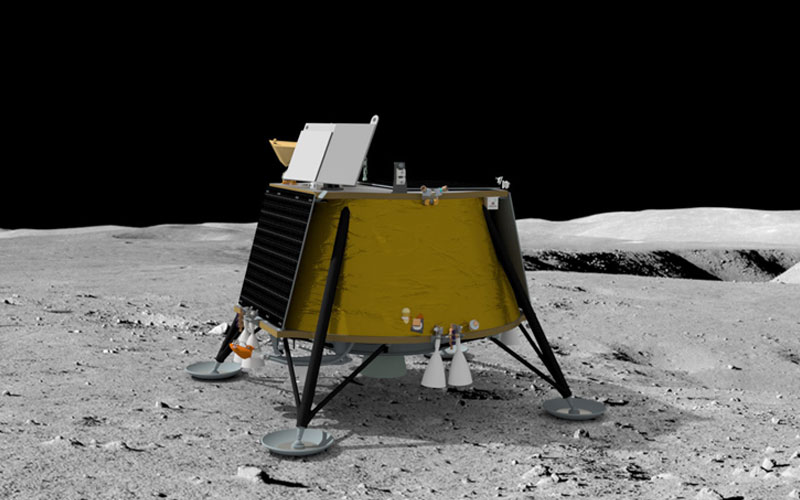
A commercial delivery to the Moon is not simply a small spacecraft purchasing a seat on a rocket. The launch begins a chain of services that must place an instrument in the right environment, keep it functioning, and return useful information to Earth. A payload can reach lunar distance without reaching its scientific destination. It can land without being positioned to make its intended measurement.
Understanding that chain helps explain both the appeal and the difficulty of commercial lunar missions. The arrangement gives researchers another way to reach the surface, while requiring them to work within a provider’s spacecraft and operating plan. The most useful way to judge a delivery is to follow the instrument’s requirements from the laboratory to the data archive.
NASA buys a service, while the provider builds the mission
NASA describes its Commercial Lunar Payload Services initiative, usually shortened to CLPS, as a way to acquire delivery services for science, exploration, and technology payloads. An individual award can cover integration, launch, flight operations, and landing. The provider’s responsibility is therefore broader than producing the landing vehicle alone.
The NASA Science explanation of CLPS makes an important distinction: NASA contracts for services instead of developing every spacecraft directly. Providers retain ownership of their landers and can offer capacity to other customers. Delivery is one part of a commercial offering that can also involve resources such as power, communications, or mobility, depending on the mission and agreement.
This structure does not make the customer and the delivery company interchangeable. A scientific team is responsible for what its instrument is intended to measure. The provider must make the instrument compatible with the mission that carries it. Successful delivery requires those responsibilities to connect without leaving an essential task between them.
A payload reservation is an interface agreement
Mass is an obvious constraint, but a payload needs more than a place in a manifest. It must fit mechanically, remain within environmental limits, use the electrical resources available, and communicate through the systems provided. An instrument that fits on a mounting panel can still be unsuitable if it needs more operating time or a different view of its surroundings.
These interfaces are a management task as well as a technical one. NASA’s Office of Inspector General examined oversight of payload costs, schedules, risks, and interface requirements in its 2024 review of CLPS. The report is a reminder that purchasing a service does not remove the work of coordinating the equipment and the customer.
For a researcher, that coordination should begin with the measurement. Does the instrument need to touch the soil, see the horizon, observe during descent, or operate when another payload is quiet? Those questions define the service it needs. Treating every kilogram as equivalent would conceal differences that can decide whether a delivered instrument produces useful science.
The landing site is part of the experiment
The Moon is not one uniform destination. Surface conditions, illumination, terrain, and the material being studied can change the value of a measurement. A broad statement that a lander will reach the Moon is therefore less informative than a description of why a particular location was selected and what observations can be made there.
NASA’s CLPS delivery directory organizes missions around their destinations and payloads. That is a useful structure for following the program: connect each delivery with its intended investigations rather than treating successive flights as interchangeable repetitions. Different missions can address different scientific questions even when their vehicles have a similar outline.
The target also has to be reachable by the spacecraft that is actually flying. A compelling scientific location and a safe landing area are not automatically the same thing. The eventual mission design has to reconcile the research objective with navigation, landing, communications, and surface-operating requirements.
Descent is an operating phase, not empty travel time
A lander must estimate its motion, control its descent, and deal with uncertainty in the surface below. NASA’s SPLICE precision-landing technology program describes tools for navigation, guidance, and hazard detection. These technologies illustrate the types of problems involved; they should not be read as a claim that every commercial lander carries the same equipment.
The engine also changes the environment it is approaching. Exhaust interacts with the surface, moving material and obscuring or altering the area around touchdown. NASA developed Stereo Cameras for Lunar Plume-Surface Studies, or SCALPSS, to observe this interaction. Cameras positioned around a lander can turn the descent itself into an investigation.
This is a useful distinction when reading a mission manifest. Some instruments are passengers until landing; others are meant to work before the vehicle stops. Their scientific timelines can therefore be different even though they share the same launch and touchdown.
Touchdown starts another sequence of work
After landing, an instrument may still need deployment, an initial checkout, and a carefully ordered series of operations. Surface success is not a single event that instantly validates every payload. Teams need to establish what is working, identify operating limits, and decide which activities can be carried out together.
NASA’s March 4, 2025 report on Blue Ghost surface operations provides a concrete example. It describes instrument work after the lander’s March 2 arrival, including descent imagery and deployment of Lunar PlanetVac. The report separates the arrival of the vehicle from the subsequent activities of its equipment. That distinction is more useful than reducing the mission to a single landing headline.
A scientific return may include engineering knowledge as well as the instrument’s principal measurement. An operating sequence can reveal how hardware behaves after transport, deployment, or exposure to the surface. Those observations matter, but they should be identified accurately rather than used to disguise an investigation that did not achieve its intended objective.
The environment sets the working day
Power and temperature create limits that a surface team cannot negotiate away. The Moon lacks Earth’s moderating weather system, and sunlight conditions are central to how a spacecraft is designed and operated. NASA’s explanation of the lunar environment describes severe changes between illuminated and dark terrain, together with radiation and impact hazards.
It is important to distinguish working through a planned sunlit period from surviving a long period of darkness. A mission’s success criteria may not require both. NASA’s lunar surface technology work includes efforts aimed at operations in demanding thermal conditions and during the lunar night. The need for such development is a reason to check the actual lifetime promised for each delivery rather than assuming that every lander becomes a permanent station.
Good reporting should preserve that boundary. The completion of a planned operating period and an unexpected early loss are different outcomes. A concept drawing of a future durable base is also not evidence that an earlier robotic delivery was built to provide the same capability.
The delivery is incomplete without a route for the data
A measurement stored on the Moon cannot support the research community until it can be communicated and interpreted. Link availability, instrument operating sequences, data volumes, and the time available for transmission have to fit together. The spacecraft’s communications resources are therefore part of the service that a payload team must understand.
NASA’s lunar communications and navigation architecture describes a broader landscape of direct links, relay capabilities, and supporting networks. It should not be treated as a promise that every mission has access to every proposed service. Near-side and far-side operations, for example, present different line-of-sight problems. A delivery plan needs to specify the path it will actually use.
When evaluating a commercial lunar mission, follow the full chain: a clearly defined investigation, compatible hardware, a suitable destination, a viable landing, an achievable operating period, and usable data returned to Earth. A launch contract, a lander photograph, or a successful touchdown can each be an important milestone. The scientific result depends on how the milestones connect.
Sources and further reading
- NASA: Commercial Lunar Payload Services overview
- NASA Science: CLPS service model
- NASA OIG: 2024 CLPS review
- NASA Science: CLPS deliveries and payloads
- NASA: SPLICE landing technology
- NASA: SCALPSS plume-surface cameras
- NASA: Blue Ghost surface operations, March 4, 2025
- NASA Science: Weather on the Moon
- NASA: Lunar surface technology
- NASA: Lunar communications and navigation architecture