
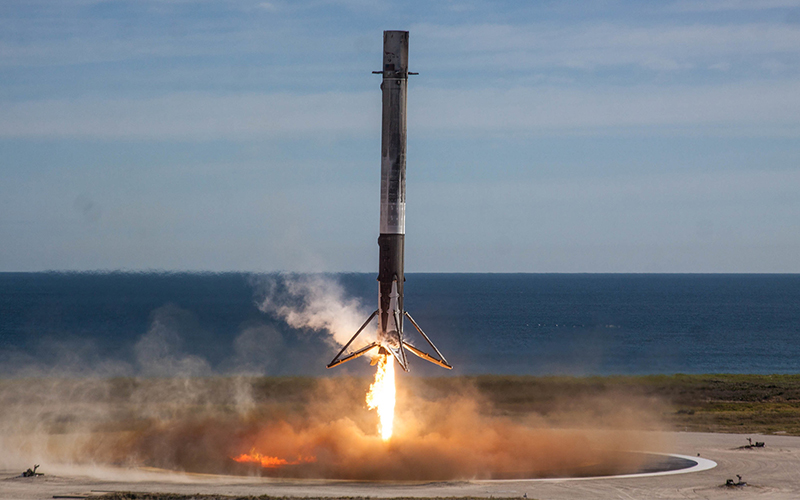
A booster landing looks like a balancing act performed above a small patch of ground. On a simulator screen, the same problem becomes a set of numbers: height, speed, mass, thrust, attitude, and remaining propellant. Moving a throttle changes those numbers, and the next few seconds reveal whether the intervention was useful.
That immediate feedback makes rocket simulation an effective meeting point between spaceflight reporting and interactive media. It can turn an unfamiliar engineering problem into something a reader can investigate. The important question is what the software actually calculates. A convincing plume and a detailed launch tower do not establish that the underlying flight model represents a real vehicle.
Start with the model, not the rocket on screen
A simulation describes selected parts of a system through rules. A simple vertical flight model might track altitude, upward velocity, vehicle mass, and propellant consumption. A more elaborate model can add sideways motion, rotation, wind, atmospheric properties, and control responses. Each additional feature creates more inputs to specify and more behavior to check.
NASA’s publicly available Trick model-rocket example provides a useful look behind the graphics. It describes a model using thrust, gravity, and drag, with a motor thrust profile and quantities that change as the calculation advances. It is an educational software example, not a description of the operational flight software used to recover a commercial booster.
That distinction should shape the reader’s expectations. A model rocket rising above a field and an orbital launch vehicle returning through the atmosphere share physical principles, but they do not share every operating condition. A simulator should identify its intended problem before presenting a successful flight as evidence of realism.
A launch is an evolving balance of forces
For a deliberately simplified vertical launch, engine thrust acts upward while gravity pulls the vehicle down. Atmospheric drag opposes motion relative to the air. The resulting acceleration depends on the net force and the vehicle’s current mass. As propellant leaves the rocket, that mass changes, so a constant thrust setting does not necessarily produce constant acceleration.
There are useful questions to ask while experimenting. Does a heavier vehicle accelerate more slowly under the same thrust? Does the propellant supply decline during a burn? Does switching off the engine allow the rocket to coast before gravity reverses its upward motion? These checks concern relationships rather than whether the software reproduces a particular launch broadcast.
NASA Glenn’s flight equations with drag illustrate how an educational calculation can isolate a manageable problem. A limited model can still explain something accurately. Trouble starts when its assumptions disappear from the presentation and a calculation designed for one situation is treated as a complete account of another.
Why the rocket keeps moving after a control input
Interactive flight becomes more interesting when the vehicle has momentum. A player who waits until the booster is directly over a target may discover that a sideways correction arrives too late. The command changes acceleration; it does not erase the velocity already accumulated. Reaching the right position and reaching it with the right velocity are separate requirements.
A similar distinction applies to rotation. In a simplified model, tilting the thrust direction can help change the flight path, but managing the vehicle’s orientation becomes part of the problem. A rocket drawn upright on the screen is not necessarily flying straight upward. Its nose direction, movement through the air, and path over the ground can differ.
NASA Glenn’s explanation of rocket control introduces mechanisms such as changing the direction of thrust. For a reader testing a simulator, the practical lesson is to inspect which controls are modeled. A button labeled “steer” might represent an engine movement, an abstract assistance system, or simply a convenient game command.
Landing requires managing speed as well as height
Consider an illustrative descent in which a simulated booster is falling toward a flat pad. Starting an upward burn changes its acceleration, but the vehicle may continue descending while its downward speed decreases. If the burn begins too late, the rocket can reach the ground before losing enough speed. Starting much earlier may use more propellant than the exercise allows.
This is a thought experiment, not a recipe for flying a real booster. A real landing problem also depends on engine characteristics, the vehicle’s condition, navigation estimates, allowable attitudes, and the environment. The simulator’s minimum thrust matters, too. A model that lets the engine smoothly produce any desired thrust gives the player a different problem from one with defined throttle limits.
Useful landing feedback therefore includes more than a success animation. Touchdown speed, lateral motion, attitude, propellant remaining, and the definition of ground contact help explain the result. If a landing succeeds despite an obviously large impact speed, the software may be applying a forgiving game rule. That can be an intentional design decision, provided it is not presented as vehicle engineering.
The clock behind the animation matters
Simulations update their changing quantities at intervals. Those updates need not correspond one for one with the pictures drawn on the screen. A program can calculate motion using a chosen time step and render the latest result whenever the display is ready. Separating those tasks helps keep the physical calculation from depending directly on the monitor’s refresh rate.
The browser’s requestAnimationFrame documentation explains why animation should account for elapsed time rather than assume that every display produces the same number of frames. This is a software timing issue, not evidence that a browser simulation is inherently inaccurate. The relevant question is how the application handles time.
A straightforward experiment is to repeat a scenario with the same initial conditions and no manual input. Materially different outcomes after changing display settings deserve investigation. Small numerical differences and a substantially altered flight are different observations. Either way, readers should record what they changed before deciding that a result demonstrates a new physical effect.
What separates an exercise from engineering evidence
A simulator becomes more useful when it shows its assumptions and lets the reader test them. A record of the initial mass, thrust model, atmospheric assumptions, and control settings gives a result context. Comparing altitude or velocity traces is more informative than comparing screenshots taken at different moments. Repeating a run also helps separate a change in the model from a change in the player’s timing.
Professional analysis adds a demanding question: does the model reproduce relevant measurements within an understood range? NASA’s Entry Systems Modeling project describes work that combines prediction tools with validation experiments for atmospheric entry. Its scope is much broader than a landing game, but it demonstrates why visualization alone is not validation.
A reader does not need access to a vehicle manufacturer’s proprietary data to learn from an educational exercise. The claim simply needs to fit the evidence. “This model demonstrates why braking must begin before touchdown” is narrower than “this software predicts how a particular booster lands.” A simplified model can support the first claim without establishing the second.
From flight simulation to interactive space media
At this point, the connection to games is practical rather than cosmetic. Both can ask users to make decisions, observe consequences, and try again. A simulation emphasizes the behavior of a defined model. A game may instead prioritize a readable challenge, progression, or a short session. A single application can combine those aims, but they should not be treated as interchangeable promises.
For readers following reusable-launch coverage, the best exercise is one that clarifies a question from the reporting. Try changing one assumption, inspect what happened, and return to the real mission with a more precise question. A successful virtual landing can be satisfying entertainment and a useful lesson about motion. It does not establish that an actual stage is ready for another launch.