
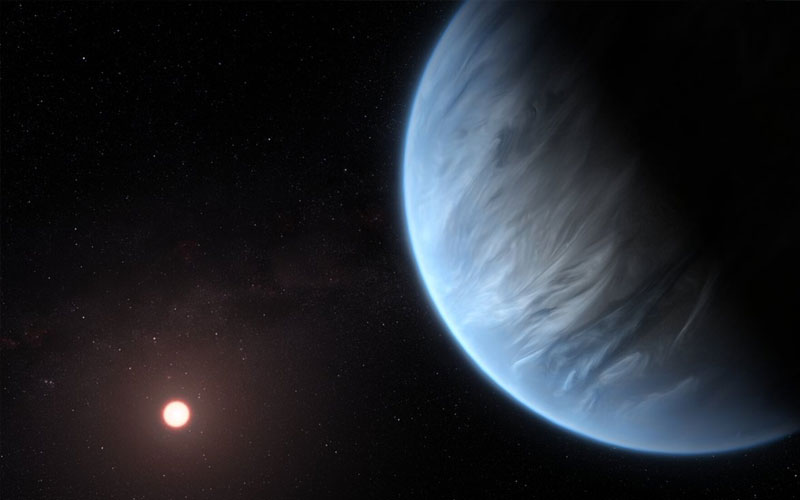
A newly announced exoplanet may be represented by a vivid image of clouds, oceans, or glowing rock. The evidence behind the announcement is usually much less pictorial: a repeated change in starlight, a shift in a spectrum, or a carefully measured displacement. The picture helps an audience imagine a distant world. It is not necessarily a photograph of that world.
Understanding the difference makes exoplanet reporting more interesting, rather than less impressive. Astronomers extract physical information from signals that combine the planet, its star, the instrument, and the observing geometry. Finding an object, establishing that it is a planet, and learning what it is like are related tasks, but they are not the same measurement.
A shadow reveals size, not a complete world
A transit occurs when a planet passes across its star from the observer’s point of view. The planet blocks some of the star’s light, producing a temporary reduction in measured brightness. NASA’s guide to finding and characterizing exoplanets explains how these repeated dips form one of the principal methods of discovery.
The depth of a transit carries information about the planet’s size relative to its star. Its timing reveals an orbital period when repeated events can be identified. The shape and duration contain additional information, but interpreting them requires a model of the system. A transit is not a measurement of the planet’s surface, and it does not by itself establish its mass or composition.
The geometry also limits what a survey can see. A planetary system can exist without being aligned to produce transits from Earth. A telescope therefore does not take an unbiased census simply by watching many stars. Its observing method selects certain kinds of signals, and its time coverage determines which repeating events it has a reasonable chance of recording.
Why observing strategy changes the discovery list
NASA’s Kepler mission made long-duration monitoring central to its search. Persistent observations allowed astronomers to look for repeating patterns rather than isolated changes. The observational record remains scientifically useful after the spacecraft’s operations have ended, because researchers can revisit the data with improved analysis and additional knowledge of the stars.
TESS uses a different survey strategy, searching broad areas of sky for transiting planets around nearby stars. Its discoveries supply targets for other instruments. The contrast illustrates an important point: one survey can be designed to measure a population, another to identify promising individual systems. Both contribute to planetary science without needing to perform the same job.
Descriptions such as Earth-sized or nearby should therefore be read literally. Size is not climate, and proximity is not habitability. A small planet may orbit so close to its star that it has little in common with Earth. Conversely, a difficult detection can still be valuable because it tests the limits of a method or improves understanding of the kinds of systems that exist.
A candidate must survive alternative explanations
A dip in light is a starting point for investigation. Stars vary, neighboring objects can contaminate a measurement, and some stellar systems can imitate a planetary transit. The question is not whether the plotted points look persuasive to an audience. It is whether the evidence adequately distinguishes a planet from plausible alternatives.
The NASA Exoplanet Archive’s overview of Kepler data products distinguishes candidate lists, false-positive classifications, and confirmed-planet records. Additional images and spectra can identify information that a discovery light curve alone cannot supply. That work explains why candidate, validated planet, and confirmed planet should not be treated as decorative alternatives in a headline.
The exact evidentiary route depends on the system and the available data. A useful discovery report explains what was measured and how competing interpretations were tested. It also identifies which quantities remain uncertain. A smaller error bar is valuable only when the model and observations justify it; visual precision in a chart is not a substitute for that explanation.
Mass and radius answer a different question together
Astronomers can seek a planet’s gravitational effect on its host star as well as its shadow. In radial-velocity observations, the star’s motion changes the wavelengths of its light. This offers a route to information about the orbiting body’s mass. Transit and radial-velocity measurements are complementary because one is primarily sensitive to size and the other to gravitational influence.
ESA’s Cheops mission specializes in precise observations of already known exoplanet systems. Improving a planet’s measured radius, when useful mass information is available, helps researchers infer bulk density. A discovery can therefore become substantially more informative through follow-up even if it does not add another object to a catalog.
Density is a constraint, not a complete interior diagram. Different arrangements of material can sometimes fit similar overall measurements. Researchers must examine the uncertainties and physical models before deciding which structures remain plausible. Saying that a world is consistent with a rocky composition is more careful than presenting an unseen cross-section as if an instrument had photographed it.
Atmospheres leave wavelength-dependent clues
During a suitable transit, some starlight can pass through a planet’s atmosphere before reaching a telescope. Different gases absorb light at different wavelengths. NASA’s explanation of spectroscopy and the types of spectra describes the physical basis for reading those signatures.
The result is a spectrum assembled from measurements, not a sample bottle of alien air. Researchers compare observations with models that account for possible molecules and atmospheric conditions. Clouds, haze, instrumental effects, and the behavior of the star can complicate the interpretation. Detecting one feature does not automatically reveal every ingredient or the entire vertical structure of an atmosphere.
Webb’s exoplanet observing methods include transmission spectroscopy, thermal-emission measurements, and observations of changes across an orbit. Each arrangement emphasizes different information. A bright, hot giant and a small temperate planet do not present equally accessible signals, even when both are described as targets for the same telescope.
More measurements do not automatically mean an answer about life
A planet’s orbit, size, mass, and atmosphere help define its physical circumstances. None alone constitutes a detection of life. The meaning of a molecular signature depends on the environment and on processes that may produce or remove that molecule. A scientific claim has to address those alternatives rather than merely list a substance associated with biology on Earth.
NASA’s discussion of reconnaissance of potentially habitable worlds emphasizes the difficulty of atmospheric observations and the wider evidence that would be needed to assess possible biosignatures. That is a reason to value incremental results. Establishing whether a particular rocky planet has an atmosphere can itself be a consequential observation.
The same care applies to nondetections. A result may rule out certain atmospheric models without proving that no atmosphere exists. What has been excluded depends on the sensitivity of the observations and the models tested. The most useful reporting states the excluded possibilities and the remaining uncertainty instead of turning an incomplete measurement into an absolute verdict.
Read the evidence beneath the illustration
When encountering an exoplanet announcement, look for the measurement method, the status of the object, and the quantities actually constrained. Check whether a mass and radius were both measured, whether an atmospheric interpretation is tentative, and whether the image is labeled as an artist’s concept. These questions make it easier to distinguish discovery from characterization without dismissing either achievement.
Space telescopes do not need to produce a familiar-looking photograph to change our understanding of planets. Their power often lies in making an extremely small signal repeatable, measurable, and open to further tests. The scientific story is the growing chain of evidence connecting that signal to a physical world, with each observing step adding information that the previous one could not provide.