
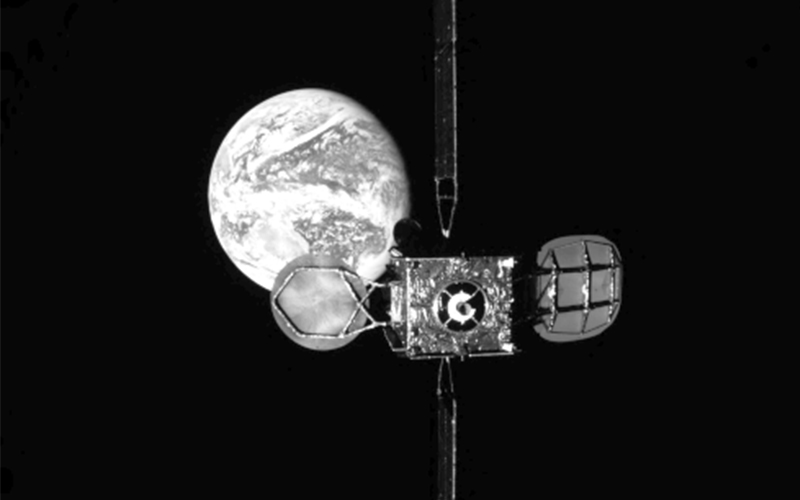
A communications satellite can reach the end of its working life while its antennas, electronics, and solar arrays still perform useful work. The limiting component may be the propellant needed to hold its position and orientation. That creates a different engineering question from replacing a broken spacecraft: can another vehicle supply the missing capability without replacing the customer’s functioning equipment?
Satellite servicing begins with that distinction. It is a family of operations, not a single technology. Inspection, propulsion assistance, refueling, relocation, and component replacement involve different interfaces and different hazards. A successful docking proves an important capability, but it does not demonstrate that every satellite can be repaired or that every servicing business will be economical.
Life extension without opening the fuel tank
Northrop Grumman’s Mission Extension Vehicle provides a concrete example. NASA’s account of its servicing collaboration explains that an MEV docks with a client in geostationary orbit and supplies propulsion and attitude-control services. The client can continue using its communications payload while the attached vehicle handles functions needed to maintain its orbital position.
This is not the same as refilling the client’s tanks. The distinction matters when reading a headline about a satellite being revived. One approach transfers a consumable; another supplies a capability from outside. A third might replace a failed unit. They can all extend useful service, but the evidence needed to evaluate them is different. Ask what the servicing vehicle physically did, what it left attached, and which spacecraft now performs the control task.
The commercial record also needs dates and individual spacecraft names. Northrop Grumman identifies February 25, 2020 as MEV-1’s first docking with Intelsat 901. Its April 2021 announcement describes MEV-2 docking with Intelsat 10-02. Those are separate missions, not interchangeable illustrations of one encounter. They establish demonstrated operations with particular clients, rather than universal compatibility.
Reaching the client is part of the service
A technician on Earth can walk around a machine, look for a connector, and stop working while considering the next move. A servicing spacecraft must first reach a compatible orbit, approach the client, determine its relative motion, and maintain a safe geometry. The encounter has to account for the client as a moving three-dimensional object, including parts that may be difficult to see under changing illumination.
Distance is therefore only one measure of progress. A vehicle may be close but badly positioned for capture. It may see the target yet still need better knowledge of its rotation or structural features. A well-controlled approach is valuable because it gives the operator options: pause, collect more information, retreat, or continue. The relevant milestone is not simply a smaller number on a range display; it is a controlled transition to the next operation.
Northrop Grumman’s MEV fact sheet describes proximity sensing and a mechanical docking system as elements of the vehicle’s design. Those systems serve different purposes. Sensors establish where the spacecraft are relative to one another; a capture mechanism must create a physical connection that can carry the required loads. Reliable navigation cannot compensate for an unsuitable mechanical interface.
A connection changes both spacecraft
Docking is the beginning of a new configuration. Two previously separate objects become a coupled system. A thruster firing now acts on the combination, and the controller must account for the mass and arrangement of both vehicles. Operations also have to protect the customer’s mission: a geometrically convenient approach is not automatically convenient for antennas, power generation, thermal limits, or communications with the ground.
That is why serviceability is more useful as a design question than as a promise made after launch. A satellite designed with accessible interfaces, reliable documentation, and known handling points presents a different problem from a spacecraft whose original designers expected it never to be touched again. Even basic information about materials, alignment, or the location of a component can become operationally important when it is no longer possible to inspect the hardware directly.
The tools are developing alongside the spacecraft. NASA’s satellite-servicing technology catalog includes work on robotic handling, relative navigation, and associated sensing. The catalog is useful for understanding the components of a servicing operation. It should not be read as a list of commercially available services with identical readiness. A licensed navigation tool, a laboratory demonstration, and an operational mission represent different stages of evidence.
Refueling an unprepared satellite is a different challenge
Servicing proposals often sound similar because they share a destination: an existing spacecraft. Their physical tasks can be very different. Attaching an external propulsion vehicle does not require the same work as reaching a fill valve, manipulating its protective hardware, connecting fluid lines, and transferring propellant. Refueling also requires compatible materials and a controlled transfer, rather than a successful mechanical connection alone.
NASA’s OSAM-1 project announcement provides a necessary counterpoint to the successful MEV dockings. NASA discontinued the project after reviewing technical, cost, and schedule problems and changes in the wider servicing market. The page retains descriptions of the planned technology alongside the cancellation announcement. Readers need to distinguish those descriptions of intent from a completed flight demonstration.
That outcome does not make rendezvous, robotics, or refueling irrelevant. It shows why a technically interesting capability must also fit a workable mission and a customer need. A proposed demonstration can produce useful hardware or knowledge without reaching its original objective. Equally, useful development work does not justify reporting the abandoned objective as an achievement. Both points belong in a credible account of the project.
The economic question is specific to the satellite
Life extension has value only when the continued mission has value. The comparison is not simply the price of a servicing launch against the price of a new satellite. An operator must consider how long the old payload can remain competitive, the time needed to obtain a replacement, the operational consequences of a service interruption, and the uncertainties introduced by the servicing operation itself.
A satellite with healthy equipment and a constrained consumable may be a stronger candidate than one with several aging subsystems. Servicing cannot make an old payload acquire capabilities it does not possess. Nor does keeping a vehicle in orbit automatically make its continued operation preferable. The useful question is which option meets the customer’s actual requirement with an acceptable combination of cost, performance, and risk.
The U.S. Government Accountability Office’s assessment of in-space servicing, assembly, and manufacturing treats potential benefits alongside technical, business, and policy challenges. That framing is more informative than treating every demonstration as the start of an inevitable mass market. Different orbital regions, interfaces, and customer fleets may support different services. A result in one market does not settle the case for another.
What a convincing servicing report should show
Start with the names of the client and servicer, the orbital setting, and the operation actually completed. Then look for the interface used, the control arrangement after docking, and the intended next step. Keep inspection separate from capture, capture separate from service delivery, and the start of a contract separate from successful operation throughout its term.
Satellite servicing is changing what can happen to hardware after launch. Its importance lies in the additional choices it may give operators, not in the idea that every old spacecraft should be saved. The most persuasive evidence is a clearly documented task performed on a clearly identified client, with its limitations stated as carefully as its success.
Sources and further reading
- NASA: satellite-servicing technologies licensed by Northrop Grumman
- Northrop Grumman: SpaceLogistics mission overview
- Northrop Grumman: MEV-2 docking announcement, April 12, 2021
- Mission Extension Vehicle fact sheet
- NASA: satellite-servicing technology catalog
- NASA: OSAM-1 project and cancellation announcement
- GAO: in-space servicing, assembly, and manufacturing assessment