
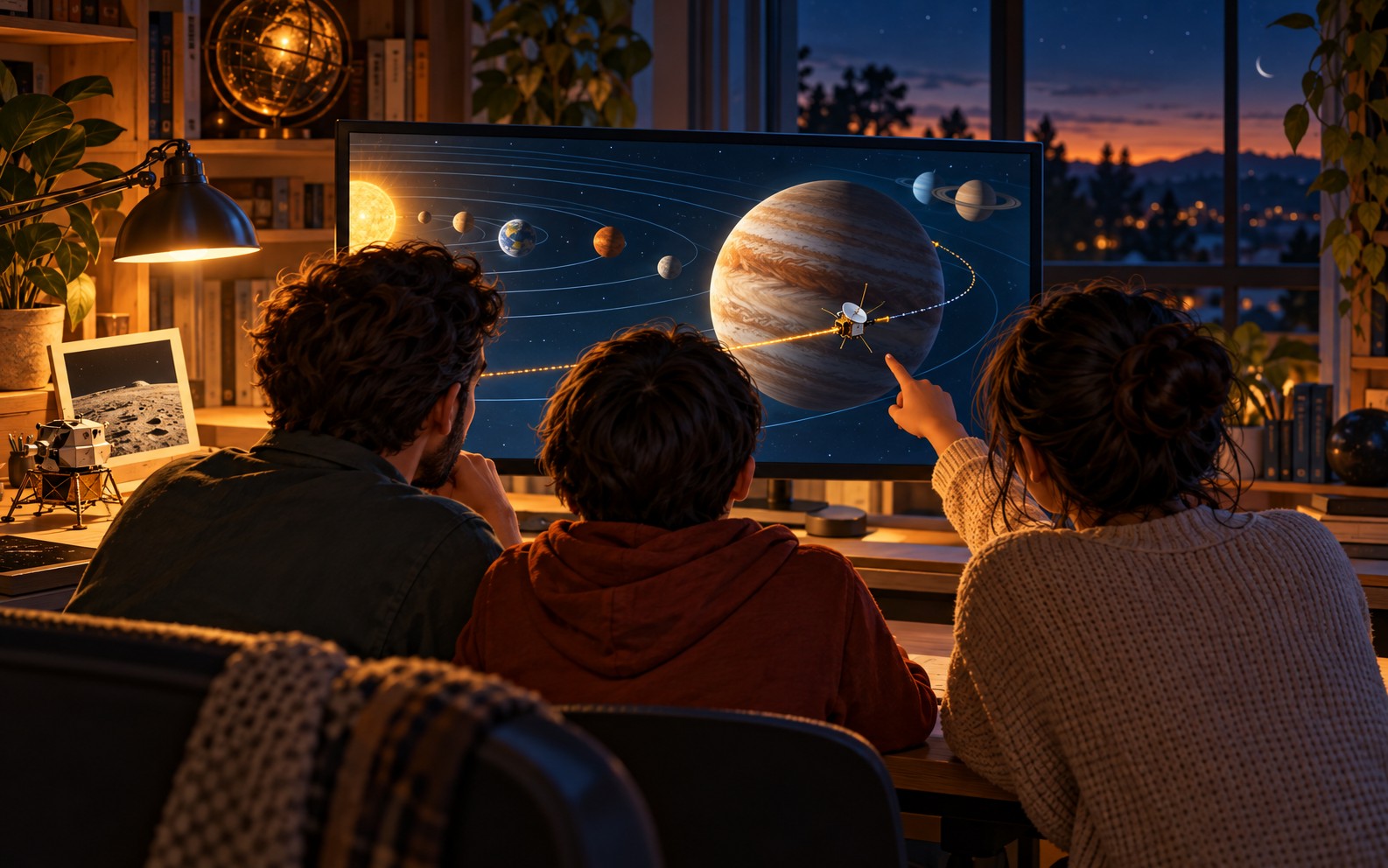
A launch can attract an audience long before a rocket leaves the pad. People follow a creator’s explanation, send questions to a livestream, share a mission animation, or contribute something to a public campaign. Their involvement may be personal and memorable even when they have no role in operating the spacecraft. That distinction is the starting point for understanding how space missions become part of digital culture.
There is no single activity called participating in space exploration. Watching an event, submitting a photograph, classifying research data, exploring a three-dimensional model, and playing a game involve different promises. They can sit within the same reader’s interests without being interchangeable. A useful account follows those differences rather than assuming that everything on a screen belongs to the same category.
Start with what the audience actually contributes
For a public-facing mission campaign, the first question is concrete: what is being submitted, and what is supposed to happen to it? A message or photograph may be a symbolic contribution. A payment may purchase a service under particular conditions. A comment beneath a launch video may simply join a conversation. None of those actions automatically gives its participant a scientific or engineering role.
Readers should look for a description of the payload or activity, the organization responsible for it, and the difference between a proposal and a completed result. A creator can explain why an initiative feels exciting, but the mission operator supplies the operational details. An announcement about a planned flight should be read alongside the date on the announcement. A later visit to an old article does not move that plan into the present.
Creators make distant missions easier to follow
Spaceflight reporting contains unfamiliar hardware, acronyms, milestones, and long periods in which little appears to happen. A creator can give that material an accessible point of entry. A demonstration, a conversation, or an audience question can turn an abstract mission into a story with understandable stakes. That is a communication role, and it can be useful without being confused with responsibility for the mission.
The same principle applies when enthusiasm moves beyond the original announcement. Someone who first notices a lunar project through a video may later want a technical explanation, a visualization, or a recreational activity. There is no requirement to take every step. Each new destination should explain what it offers, so the reader can choose a deeper account of the real mission or a different way to spend time with the subject.
Following a visualization is different from controlling a spacecraft
A visualization can make an otherwise invisible relationship easier to inspect. A reader may rotate a view, follow a trajectory, or compare a spacecraft with the world it is studying. The controls change the presentation. They do not necessarily change the underlying event, and they do not transmit instructions to the real spacecraft.
NASA’s Eyes applications provide an example of browser-based, three-dimensional exploration using mission data and imagery. This makes them a useful reference point for discussing interactive interpretation. Readers should still distinguish a displayed model, its data, and the particular interaction offered by the interface. Being able to move a camera around a scene is a different kind of agency from choosing a mission’s physical course.
That distinction also helps explain the appeal of replay. A viewer can revisit a sequence and inspect a moment that passed too quickly in a broadcast. The benefit is attention and perspective. It is not evidence that a simplified screen representation includes every constraint faced by the team responsible for the original flight.
Research participation has its own instructions
Some public activities are designed to support research rather than to tell a story or offer recreation. NASA’s citizen-science project directory is a starting point for finding projects with their own goals and participation requirements. The important step is to read the individual project instructions before deciding what kind of contribution is being requested.
A task involving observations or data should explain what participants do and how their work fits into the project. The interface may feel approachable, but its purpose is not established by its visual style. A cheerful design does not make a research task a game, just as a serious-looking control panel does not establish that a recreational activity produces scientific results.
Educational activities make selected ideas playable
Between watching a visualization and conducting a research task, there is another useful format: an activity built to demonstrate a limited idea. It might ask a learner to arrange steps, manage a resource, or make a prediction and inspect the result. The activity can be engaging because it narrows a complicated subject to decisions a person can understand within a short session.
In NASA Space Place’s Explore Mars, players choose a rock and send a sequence of commands for a simulated rover to reach and investigate it. The instructions connect play with planning. That is an example of an educational activity, not access to an operating rover. Its value comes from the particular relationship it makes visible, rather than a promise to reproduce every condition on Mars.
For a reader moving from a creator’s mission story into an educational activity, this is a sensible change of purpose: first follow what a real mission is attempting, then examine one idea through interaction. The second activity does not validate a creator’s commercial campaign or imply that its organizers are involved in the educational resource.
When space becomes a setting for recreation
Other interactive experiences use space primarily as a setting. A game can revolve around navigation, resource allocation, timing, or a fictional adventure. Some games model aspects of flight; others use familiar imagery to give a puzzle its atmosphere. Both can be enjoyable. The useful question is what the player does, rather than whether the background contains a planet.
Readers who want to explore that recreational side can continue with our guide to space-themed browser games, from simulation to casual play. It explains the differences between those formats and what to look for in their controls and claims. This is a separate reading choice after discussing interactive media, not an assertion that a lunar payload or a NASA mission involves an online game.
Choose the experience that fits the question
A reader trying to establish whether a spacecraft launched needs a dated mission report. Someone trying to understand a sequence may prefer a visualization or a focused educational activity. Someone looking for a short break may prefer a game with clear rules. Moving among these formats is reasonable when the purpose of each destination remains visible.
The same care applies to practical expectations. Before beginning an activity, check whether it requires an account, how it explains saving progress, and whether it is comfortable to use on the current device. An educational resource and a commercial entertainment product may make different demands. A link from a space publication should describe the destination accurately instead of making broad promises about compatibility or learning outcomes.
Keep curiosity connected to clear explanations
Space-related entertainment works best when curiosity remains the thread. A creator’s story can introduce a mission; a visualization can make its geometry easier to inspect; an activity can invite a limited set of decisions. Those connections are meaningful because each format offers a different way to engage, not because the formats are all secretly the same thing.
NASA’s learning resources offer another starting point for readers seeking material organized around learning. Alongside mission reporting and clearly described recreational coverage, resources like these give readers choices. The result is a more useful path through space culture: follow the real story, understand what an interactive experience represents, and choose the kind of participation that matches the interest that brought you there.